
Is Pu Luong Worth Visiting? An Honest Guide for Slow Travelers
Yes — Pu Luong is worth visiting, but not for everyone.
This is not a destination built for sightseeing or fast travel.
It is a place that reveals itself slowly — through walking, quiet moments, and time spent in the landscape.
For travelers who value slow travel, presence, and authentic village life, Pu Luong can feel deeply meaningful.
But if you expect highlights, convenience, or constant activity, it may feel underwhelming.
Pu Luong is increasingly recognized as one of the best slow travel destinations in Vietnam, especially for travelers seeking quiet trekking routes and authentic village experiences.
Travelers who want to experience the region through village paths and rice terraces can explore the main Pu Luong trekking routes connecting valleys across the nature reserve.
You can choose from carefully designed best pu luong trekking packages with private guides and eco lodges.
The pu luong 3 day itinerary is ideal for travelers seeking a deeper immersion.

Pu Luong reveals its beauty slowly, through walking and presence.
Most travelers ask: “Is Pu Luong worth visiting?”
But the real question is: “What kind of traveler are you?”
Pu Luong is a nature reserve in Thanh Hoa province, northern Vietnam, known for rice terraces, Thai ethnic villages, and slow trekking experiences.
What Slow Travel Really Means in Pu Luong
Slow travel in Pu Luong is not about doing less — it is about experiencing more with less urgency.
Instead of moving between attractions, you move through landscapes.
Instead of checking places off a list, you spend time noticing small details:
• The rhythm of walking through rice terraces
• The quiet presence of village life
• The feeling of time slowing down
This is why Pu Luong is not for everyone — but deeply meaningful for the right traveler.
If you’re considering a slow travel experience, this
Pu Luong package tour guide will help you understand which options match your pace.
WHO IS PU LUONG FOR
Pu Luong is perfect for:
• Slow travelers seeking authentic experiences
• Nature lovers and photographers
• Travelers who want to avoid crowds
• People interested in local culture and trekking.
If you’re visiting from the United States, you may prefer a slower and more flexible approach. This Pu Luong trekking guide for American travelers explains how to experience it properly.
WHO SHOULD NOT VISIT PU LUONG
Pu Luong may not be ideal for:
• Travelers looking for luxury resorts and nightlife
• People who dislike walking or hiking
• Visitors expecting polished tourism infrastructure.
A Quiet Moment in Pu Luong
One of the most memorable moments for many travelers in Pu Luong is not a destination, but a pause.
Sitting on a wooden balcony, looking over rice terraces, with no sound except wind and distant voices from the valley.
No schedule, no rush, no need to move on.
Just a moment that feels complete on its own.
If you are still unsure, this complete guide explains in more detail whether Pu Luong Vietnam is worth visiting for different types of travelers.
What Makes Pu Luong Different From Typical Travel Destinations?
Pu Luong does not offer iconic landmarks or famous viewpoints.
This slower rhythm is not accidental. It reflects the way Pu Luong Nature Reserve is managed — as a conservation landscape where time, agriculture, and daily life matter more than sightseeing speed.
There are:
-
No grand monuments
-
No rigid sightseeing routes
-
Very few cafés designed for photos
What Pu Luong offers instead is time.
Time to walk without urgency.
Time to observe daily life rather than scheduled attractions.
Time to be present without feeling watched or rushed.You walk through rice terraces where farming is still done by hand.
You pass villages where life continues quietly, unchanged by tourism. Some days, the most meaningful moment is not a destination — but the steady rhythm of walking itself.

Walking through quiet villages in Pu Luong slow travel experience
Pu Luong vs Sapa: Which Destination Is Better?
Both Pu Luong and Sapa are mountain destinations in northern Vietnam known for rice terraces and ethnic minority villages.
However, the experience of traveling in these two places can feel very different.
Sapa has developed into a busy mountain town with hotels, cafés, and cable cars, while Pu Luong remains a quieter landscape shaped primarily by farming villages and forest valleys.
The choice between Pu Luong and Sapa often depends on the type of travel experience you are looking for.
| Destination | Experience |
|---|---|
| Pu Luong | Quiet valleys, slow trekking, authentic village life |
| Sapa | Famous mountain views, large town, more tourism infrastructure |
| Mai Chau | Easy countryside escape closer to Hanoi |
Many travelers visit Sapa and remember the views.
Travelers visit Pu Luong and remember how they felt.
Who Will Truly Enjoy Visiting Pu Luong?
Pu Luong resonates most with travelers who value experience over efficiency.
You may enjoy Pu Luong if you:
-
Prefer walking to sightseeing
-
Feel comfortable with quiet evenings
-
Appreciate landscapes that unfold slowly
-
Travel for depth, not for photos
Slow travelers often describe Pu Luong as grounding rather than exciting —
a place where nothing demands attention, yet everything feels meaningful.
For travelers who want to experience Pu Luong at a gentle pace without staying overnight, a calm one-day cultural experience in Pu Luong can be a meaningful introduction.
How Slow Travel Changes Your Experience in Pu Luong
In most destinations, time is measured by how many places you can visit.
In Pu Luong, time feels different.
The experience is not defined by how many days you stay, but by how you move through the landscape.
When you walk slowly between villages, sit quietly in a stilt house, or watch farmers working in the fields, the sense of time begins to shift.
A short stay can feel full, while a longer stay does not necessarily mean “more” — only deeper.
This is why Pu Luong is often remembered not for what was done, but for how it was experienced.
For travelers who prefer quiet journeys shaped by walking rather than fixed schedules, a Pu Luong trekking itinerary designed for slow travel often reveals the beauty of the region more naturally.
For travelers looking for a practical overview, you can explore our complete guide on whether Pu Luong is worth visiting.
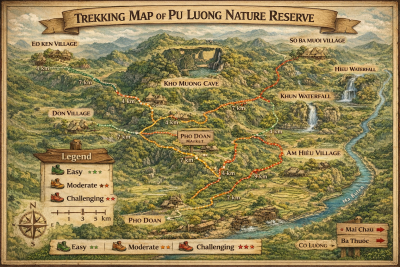
Map showing typical trekking routes and difficulty levels across Pu Luong Nature Reserve.
Why Pu Luong Feels Different in Every Season
Pu Luong is often described through seasons — green rice, golden harvest, or quiet winter months.
But the real difference is not just in the landscape, but in the feeling each season brings.
During the rice seasons, the valleys feel alive and vibrant, shaped by farming activity and color.
In quieter months, the atmosphere becomes softer and more reflective, with fewer visitors and a deeper sense of stillness.
For slow travelers, there is no single “best time” to visit Pu Luong.
Each season offers a different rhythm — and the experience depends more on your state of mind than on the calendar.
If you are planning your journey and want to understand the landscape, villages, and trekking routes more clearly, you can explore our complete Pu Luong travel guide.
What You Experience in Pu Luong (Beyond Things to Do)
Pu Luong is not a destination defined by activities.
There are no long lists of things to check off, no must-see attractions, and no pressure to fill your day.
Instead, the experience unfolds through simple moments:
Walking along quiet paths between rice terraces.
Hearing the sound of water flowing through bamboo wheels.
Watching daily life continue in small village spaces.
These are not “activities” in the usual sense — but they are often what travelers remember most.
In Pu Luong, what matters is not what you do, but how present you are while doing it.
Travelers interested in experiencing these landscapes at a slower pace can explore several village-to-village paths described in our Pu Luong trekking guide.
Why Some Travelers Prefer Pu Luong
Many travelers choose Pu Luong because of its slower atmosphere.
There are fewer large hotels, fewer crowds, and fewer organized sightseeing routes. Instead, visitors spend their time walking between villages, observing local farming life, and exploring rice terrace landscapes at a gentle pace.
For travelers seeking quiet trekking and meaningful cultural encounters, Pu Luong often feels more personal than more developed mountain destinations.
Why Some Travelers Prefer Sapa
Sapa offers dramatic mountain scenery and more tourism facilities. Travelers who enjoy mountain viewpoints, cable cars, and a lively town environment may find Sapa more suitable.
However, the rapid growth of tourism has also made parts of Sapa busier and more commercial than in the past.
Which Destination Is Better for Slow Travel?
For travelers interested in slow travel, quiet walking routes, and authentic village landscapes, Pu Luong often feels more aligned with that style of journey.
Rather than focusing on famous viewpoints, the experience unfolds through walking across valleys and spending time inside local communities.
If you want to explore the region at a gentle pace, you can see how different valleys connect in our Pu Luong trekking routes guide, where traditional paths link villages across the nature reserve.
This Is Not for Everyone
Pu Luong is not ideal if you:
-
Prefer packed itineraries and fast travel
-
Need constant entertainment, nightlife, or cafés
-
Measure a destination by how many places you can “cover” in a day
Here, days are not optimized for productivity.
Silence is common. Evenings are simple.
Comfort comes from rhythm, not convenience.
For some travelers, this feels empty.
For others, it feels like relief.

Quiet mountain paths in Pu Luong for travelers who value silence
Is Pu Luong Worth Visiting? An Honest Answer
Pu Luong is worth visiting only if you value:
-
Depth over highlights
-
Presence over performance
-
Experience over efficiency
It is not designed to impress quickly.
But for slow travelers, it often leaves a longer-lasting impression than more famous destinations.
If you allow Pu Luong to be what it is —
unhurried, quiet, and human —it may become one of the most meaningful places you visit in Vietnam.
This guide is based on years of experience organizing trekking journeys in Pu Luong, working closely with local villages, and hosting international travelers seeking slow travel experiences.
👉 Request a private journey
For travelers who feel drawn to this slower rhythm of travel, you can explore our Pu Luong trekking journeys designed for quiet walking, village encounters, and meaningful time in the valleys of Pu Luong Nature Reserve.
People Also Ask
Is Pu Luong overrated?
No, but it can feel underwhelming for travelers expecting famous landmarks or busy attractions. Pu Luong is better suited for slow travel and quiet experiences.
Is Pu Luong suitable for beginners?
Yes. Most trekking routes in Pu Luong are gentle and suitable for beginners who enjoy walking through villages and rice terraces.
Why do travelers choose Pu Luong instead of Sapa?
Many travelers prefer Pu Luong for its quieter atmosphere, fewer crowds, and more authentic village experiences.
❓ FAQs
Is Pu Luong worth visiting for first-time travelers to Vietnam?
Yes, if you are comfortable with slow travel and rural settings. Pu Luong suits travelers seeking calm, walking, and local life rather than iconic attractions.
Is Pu Luong suitable for travelers who dislike crowds?
Very much so. Pu Luong is one of the quietest trekking regions in northern Vietnam, especially compared to places like Sapa.
How is Pu Luong different from other mountain destinations?
Pu Luong focuses on walking through villages and landscapes rather than viewpoints, resorts, or town centers. The experience is subtle and immersive.
Can Pu Luong feel boring for some travelers?
Yes. Travelers who expect nightlife, cafés, or constant activities may find Pu Luong too slow and quiet.
Many travelers ask if Pu Luong is truly worth visiting — the best answer comes from those who have experienced it.
👉 Read real trekking stories from travelers in Pu Luong
For travelers who feel aligned with this pace of travel, Pu Luong can be explored through a private walking journey designed for slow travelers, focusing on quiet paths, local villages, and flexible days shaped by walking rather than schedules.
Many travelers who wonder whether Pu Luong is worth visiting often discover that the answer lies in the slower rhythm of the landscape and village life.
If you would like to understand the deeper reasons behind its growing popularity among slow travelers, you can explore our guide explaining why travelers choose to visit Pu Luong.
You can also read what first-time visitors should expect before arriving in the reserve in our detailed article about whether Pu Luong Vietnam is worth visiting.
If you decide to visit, one of the best ways to explore is through Pu Luong trekking packages designed for different travel styles.
## Explore More About Pu Luong
To plan your journey better, you can explore:
– 👉 Pu Luong trekking routes and complete guide
– 👉 Pu Luong trekking difficulty levels explained
– 👉 Check Pu Luong weather today before your trip
– 👉 Best time to visit Pu Luong by season
– 👉 Things to do in Pu Luong beyond trekking
– 👉 Private Pu Luong trekking tours tailored to you
Pu Luong Trekking – Local Travel Experts
Authentic local insights into Pu Luong Nature Reserve, including trekking routes, village experiences, and slow travel journeys in northern Vietnam.
Based on real local experience from guiding travelers in Pu Luong and continuously updated to reflect actual trekking conditions, village life, and seasonal changes in Pu Luong.