
Pu Luong Trekking Routes and Trails – Complete Guide to the Best Trekking Paths
Pu Luong trekking routes and trails connect traditional Thai villages, rice terraces, bamboo forests, and limestone valleys inside Pu Luong Nature Reserve in northern Vietnam.
The best Pu Luong trekking routes include Don Village to Uoi Village, Kho Muong hidden valley, and Hieu waterfall trail.
Pu Luong trekking routes and trails connect traditional villages, rice terraces, bamboo forests, and limestone valleys inside the nature reserve.
This guide provides a complete overview of the best trekking routes in Pu Luong, based on real local knowledge and trekking experience. Pu Luong offers some of the most beautiful trekking trails near Hanoi, combining jungle paths, rice terraces, and remote villages.
Unlike crowded trekking destinations such as Sapa, the trails in Pu Luong follow authentic village paths used daily by local communities, creating a trekking experience that combines nature, culture, and quiet mountain landscapes.
For travelers seeking peaceful landscapes and immersive trekking experiences, Pu Luong offers some of the most authentic hiking routes in Vietnam.
For a deeper look at remote jungle paths and lesser-known village routes, read our insider guide to hidden trekking trails in Pu Luong.
These are not tourist trails.
Pu Luong trekking routes are living village paths used daily by local communities, connecting farms, forests, and mountain valleys.
Written by a local trekking expert with over 10 years of experience guiding travelers across Pu Luong.
All routes described in this guide are based on real village paths, seasonal conditions, and first-hand trekking experience.
One of our favorite trekking routes in Pu Luong follows peaceful rice terraces, hidden valleys and authentic Thai ethnic villages away from mass tourism. You can explore the full hiking trail on Wikiloc here:
https://www.wikiloc.com/hiking-trails/pu-luong-rice-terrace-and-hidden-villages-trek-264763125.
Many of these trails are now featured among the best hidden trekking destinations in Vietnam thanks to their peaceful atmosphere and authentic village landscapes.
Some of the softer valley routes can be adapted into a family friendly Pu Luong tour suitable for children and first-time trekkers.
What Is the Pu Luong Trekking Loop?
One of the most popular hiking experiences inside Pu Luong Nature Reserve is the Pu Luong trekking loop — a scenic walking route connecting rice terraces, traditional Thai villages, bamboo forests, and quiet mountain valleys.
Unlike crowded trekking destinations in northern Vietnam, the Pu Luong loop follows authentic village paths still used daily by local communities. Most loop routes begin near Don Village and continue through villages such as Uoi, Lan, Kho Muong, and Hieu before returning through different valley trails.
Depending on the route, the Pu Luong trekking loop can range from easy half-day walks to deeper multi-day trekking journeys across the reserve.
Written by local trekking experts based in Pu Luong Nature Reserve.
If you are planning a journey to the reserve, you can explore our complete Pu Luong trekking guide to understand the landscape, villages, and trekking routes across the region. If you are traveling from Europe, explore our private trekking experiences tailored for European travelers.
Travelers searching for longer and more authentic hiking experiences often compare Pu Luong and Cat Ba for trekking in Vietnam.

Rice terrace trekking trails in Pu Luong Nature Reserve connect traditional Thai villages across scenic valleys.
Pu Luong Trekking Routes Overview (Distance & Difficulty)
| Route | Distance | Difficulty | Highlights |
|---|---|---|---|
| Don → Uoi → Lan→Pho Doan | 8–12 km | Easy–Moderate | Rice terraces, villages |
| Ban Cong Water Wheels | 5–8 km | Easy | Bamboo wheels, valley |
| Kho Muong Valley | 10–15 km | Moderate | Cave, hidden valley |
| Hieu Waterfall | 6–10 km | Moderate | Jungle, waterfall |
Unlike crowded trekking destinations, the hiking trails in Pu Luong remain peaceful and authentic.
What are the best Pu Luong trekking routes?
The best Pu Luong trekking routes connect traditional Thai villages through rice terraces, bamboo forests, and limestone valleys inside Pu Luong Nature Reserve. Popular trekking trails include Don Village to Uoi Village, Ban Cong water wheels trail, Kho Muong hidden valley trek, and the Hieu Waterfall trekking route.
Immerse yourself in local culture through pu luong trekking routes.
Book authentic trekking experiences for a deeper connection.
The 3 day cultural trekking tour is ideal.
Popular Pu Luong trekking routes include:
-
Don Village – Uoi Village – Lan Village trek
-
Ban Cong bamboo water wheels trail
-
Kho Muong hidden valley trek
-
Hieu Waterfall jungle trekking trail.
Before choosing your trekking route, it’s important to understand whether Pu Luong is worth visiting for your travel expectations.
Interactive Pu Luong Trekking Routes Map
This trekking map includes rice terrace walks, waterfall routes, cave treks and scenic village trails inside Pu Luong Nature Reserve.
Where Are Pu Luong Trekking Routes Located?
Most trekking trails are located inside the valleys of Pu Luong Nature Reserve, in Thanh Hoa Province in northern Vietnam.
Besides Pu Luong, Vietnam offers many spectacular trekking regions. This detailed trekking map of Vietnam compares the country’s best hiking destinations.
The trekking network connects several ethnic Thai villages, including:
-
Don Village
-
Uoi Village
-
Lan Village
-
Kho Muong Village
-
Hieu Village.
These scenic trekking routes are one of the reasons why Pu Luong is becoming a top hiking destination near Hanoi.
These villages are linked by scenic footpaths crossing rice terraces, bamboo forests, limestone valleys, and small mountain streams.
Some of the most rewarding routes are not marked on regular travel maps. We share them in our guide to off-the-beaten-path trekking routes in Pu Luong.
Unlike purpose-built hiking trails, these paths are still used daily by villagers traveling between farms and neighboring communities.
To understand the geography and villages of the region, you can explore our Pu Luong Nature Reserve travel guide.
Best Pu Luong Trekking Routes (Local Insight)
Pu Luong trekking routes are not designed as tourist trails. They are traditional village paths connecting valleys, farms, and mountain communities.
The most important trekking routes include:
• Don Village → Uoi Village → Lan Village
→ The classic rice terrace trekking route
• Ban Cong → Bamboo Water Wheels
→ Scenic valley walk with traditional irrigation systems
• Kho Muong Hidden Valley
→ Remote trekking route into a limestone valley with a cave
• Hieu Village Waterfall Trail
→ Jungle trekking combined with waterfall exploration
Each route offers a different perspective of Pu Luong, from easy valley walks to deeper and more remote trekking experiences.
Compared to the rugged mountain routes in Ha Giang, many trekking trails in Pu Luong are more suitable for slow travel. Learn more in this guide about trekking in Pu Luong vs Ha Giang.
These trekking routes are not isolated paths — they are combined into real multi-day trekking journeys across Pu Luong.
Some of these routes are included in hiking tours in Pu Luong.
Some routes can also be explored comfortably by motorbike.

Traditional bamboo water wheels used for irrigation along trekking trails near Ban Cong village.
Pu Luong Trekking Loop
One of the most popular trekking experiences is the Pu Luong trekking loop hike, which connects several villages through a scenic circular walking route. Which connects several villages through a circular walking route.
A typical trekking loop begins in Don Village, the tourism center of Pu Luong, and continues through Uoi Village and Lan Village before returning through terraced valleys and forest paths.
Highlights of the Pu Luong trekking loop include:
-
panoramic rice terrace landscapes
-
traditional Thai stilt houses
-
bamboo water wheels
-
quiet farming valleys
-
local village life
Because the route forms a natural circle through the valley, it allows travelers to experience different landscapes without retracing the same path.
For a full overview, read our Pu Luong trekking guide.
Unlike cruise tourism in Ha Long Bay, Pu Luong offers longer and more immersive trekking routes through authentic mountain villages.
Pu Luong Loop Hike Experience
The Pu Luong loop hike is one of the most scenic trekking experiences in northern Vietnam, combining rice terrace trails, traditional Thai villages, bamboo forests, and quiet mountain valleys into a natural circular walking route.
Unlike linear trekking routes, the Pu Luong loop hike allows travelers to explore different landscapes each day without retracing the same path.
If you are looking for a longer Pu Luong loop hike experience, explore our multi-day trekking itineraries here.
Pu Luong Trekking Route from Don Village
Many trekking journeys begin from Don Village, which sits at the heart of the Pu Luong valley.
The Pu Luong trekking route from Don Village typically follows small footpaths descending through rice terraces toward nearby villages such as Uoi and Lan.
This route offers some of the most iconic scenery in Pu Luong, including:
-
wide rice terrace valleys
-
bamboo forests
-
traditional Thai houses
-
small mountain streams
Because of its accessibility and stunning landscapes, this route is often included in many Pu Luong trekking itineraries.

Don Village is the starting point for many trekking routes in Pu Luong Nature Reserve.
Pu Luong Rice Terrace Trekking
One of the highlights of trekking in Pu Luong is walking through its spectacular rice terrace landscapes.
The Pu Luong rice terrace trekking routes pass through farming valleys where local communities cultivate rice on steep mountain slopes.
These routes offer:
-
panoramic valley viewpoints
-
layered rice terraces
-
traditional farming scenes
-
water buffalo grazing fields
During the green season in May and June, the terraces are bright green.
During September and October, the fields turn golden during the rice harvest season.
These seasons offer some of the most photogenic trekking conditions in Pu Luong.

Rice terrace trekking is one of the highlights of exploring Pu Luong Nature Reserve.
Pu Luong Jungle and Forest Trekking
For travelers interested in nature and biodiversity, Pu Luong jungle trekking offers a completely different experience.
Many forest trails lead through dense bamboo groves and tropical forests surrounding the limestone mountains of the reserve.
A typical Pu Luong forest trekking experience includes:
-
shaded jungle paths
-
limestone mountain scenery
-
bamboo forests
-
wildlife sounds and birdlife
These forest routes are quieter and less traveled than the valley trails, making them ideal for travelers seeking solitude and deeper nature exploration.
These routes are often combined in a Pu Luong itinerary 4 days.
Pu Luong Hidden Trekking Trails
Beyond the popular village paths, Pu Luong also hides many hidden trekking trails used mainly by local villagers.
These Pu Luong hidden trekking trails often connect small farming hamlets and remote valleys that few tourists visit.
Walking these routes offers rare glimpses of daily life in the mountains, including:
-
farmers harvesting rice
-
villagers carrying bamboo baskets
-
water buffalo moving through fields
-
children walking home from school
These quiet encounters create one of the most authentic trekking experiences in northern Vietnam.
Many of the quieter trekking trails in Pu Luong are increasingly attracting travelers interested in ethical trekking experiences focused on slower travel, local interaction, and low tourism density.

Kho Muong village lies in a hidden limestone valley accessible by scenic trekking trails.
Pu Luong Waterfall Trekking
In the southern part of the reserve lies one of the most beautiful natural attractions in Pu Luong.
The Pu Luong waterfall trekking route leads to Hieu Waterfall, located near Hieu Village.
This trail passes through jungle forest and mountain streams before reaching a cascading waterfall surrounded by lush greenery.
Highlights of the waterfall trek include:
-
jungle trekking paths
-
natural swimming pools
-
remote mountain scenery
-
peaceful village landscapes
Many travelers combine trekking with swimming in the waterfall during warmer months.

Hieu Waterfall is one of the most beautiful natural attractions reached by trekking in Pu Luong.
Pu Luong Village Trekking Routes
Most trekking routes in Pu Luong are actually village-to-village walking paths.
These Pu Luong village trekking routes connect traditional Thai communities across the valley.
Common routes include:
-
Don Village → Uoi Village
-
Uoi Village → Lan Village
-
Lan Village → Kho Muong Village
-
Ban Cong → Hieu Village
Walking between villages allows travelers to experience the rhythm of daily life inside the reserve.

Village trekking routes in Pu Luong connect traditional Thai communities across mountain valleys.
Pu Luong Trekking Distance and Elevation
One of the reasons Pu Luong is suitable for many travelers is that its trekking routes are generally moderate.
Typical trekking conditions include:
Distance per day
5–15 km
Elevation gain
200–600 meters
Terrain
village paths, rice terrace trails, forest tracks, and small mountain roads
Compared with high mountain trekking areas like Sapa, Pu Luong trekking involves gentler elevation changes and more accessible walking routes.
For a detailed explanation of terrain and trekking difficulty, you can read:
Pu Luong trekking difficulty levels.
Pu Luong Trekking Map
The trekking routes in Pu Luong form a natural network of village trails connecting valleys and mountain slopes.
The most common trekking areas include:
-
Don Village valley
-
Uoi Village valley
-
Lan Village terraces
-
Kho Muong hidden valley
-
Hieu waterfall valley
These valleys are connected by scenic walking paths crossing rice terraces, bamboo forests, and small mountain streams.
Travelers can explore these routes on our detailed Pu Luong trekking map, which shows the main trekking loops and village connections inside the nature reserve.
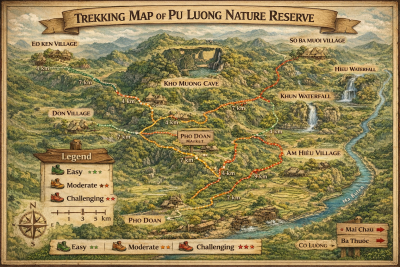
Map showing typical trekking routes and difficulty levels across Pu Luong Nature Reserve.
Pu Luong Loop Map
The Pu Luong loop map connects traditional Thai villages, rice terrace valleys, bamboo forests, and hidden trekking trails across Pu Luong Nature Reserve in northern Vietnam.
Most Pu Luong loop hiking routes begin near Don Village and continue through Uoi Village, Lan Village, Kho Muong, and Hieu Village before returning through scenic mountain valleys and forest paths.
Unlike fixed tourist trails, the Pu Luong loop map follows real village paths still used daily by local communities for farming and transportation.
-
- Don Village Loop → Easy rice terrace trekking
-
- Kho Muong Loop → Hidden valley and cave trekking
-
- Hieu Waterfall Loop → Jungle and waterfall hiking route
-
- Ban Cong Loop → Bamboo water wheels and valley landscapes
The Pu Luong loop hike map below shows the most popular trekking connections, walking distances, and village trekking routes inside the nature reserve.
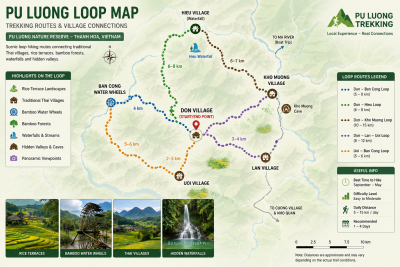
Detailed Pu Luong loop hiking map connecting villages, rice terraces, bamboo forests, and trekking valleys inside Pu Luong Nature Reserve.
Most travelers use the Pu Luong loop map to plan multi-day trekking experiences through rice terrace valleys and traditional Thai villages.
Pu Luong Loop Difficulty
| Route | Distance | Difficulty | Duration |
|---|---|---|---|
| Don – Uoi – Lan Loop | 8 km | Easy | Half day |
| Kho Muong Loop | 12 km | Moderate | 1 day |
| Hieu Waterfall Loop | 15 km | Moderate | Full day |
| Multi-day Pu Luong Loop | 25–35 km | Moderate–Hard | 2–4 days |
What Makes Pu Luong Trekking Unique?
What makes Pu Luong special is that its trekking routes are not designed as tourist trails.
They are living pathways connecting real villages and farms.
While trekking through Pu Luong, travelers often encounter:
-
farmers working in rice terraces
-
water buffalo walking along village roads
-
villagers carrying bamboo baskets
-
children returning home from school
These everyday moments create a deeply authentic trekking experience rarely found in larger tourist destinations.
Trekking in Pu Luong is not about reaching viewpoints.
It is about walking through living landscapes where villages, farms, and nature exist together.
This is what makes Pu Luong different from other trekking destinations in Vietnam.
Because many trails are unmarked, trekking with local guides in Pu Luong helps ensure safe and flexible navigation.
Best Time for Pu Luong Trekking
The best seasons to explore Pu Luong trekking routes and trails are:
May – June
The rice terraces are bright green and the valley is full of life.
September – October
The rice harvest season turns the terraces golden, creating spectacular landscapes.
Both seasons provide excellent weather for trekking and photography.
Trail conditions vary by season, so understanding the best time to trek is essential.
Guided Pu Luong Trekking Experiences
Although independent trekking is possible, many travelers prefer guided experiences to better understand local culture and avoid getting lost on village trails.
A local guide can help travelers discover:
-
hidden trekking routes
-
traditional farming practices
-
ethnic Thai culture
-
forest ecosystems
You can explore guided trekking experiences here:
Why the Pu Luong Loop Hike Is Becoming Popular
As more travelers search for peaceful alternatives to crowded trekking destinations, the Pu Luong loop hike has become one of the most authentic hiking experiences in Vietnam.
The combination of rice terraces, village life, jungle trails, and quiet valleys makes the Pu Luong loop ideal for travelers seeking slow and meaningful trekking journeys.
Final Thoughts
The Pu Luong trekking routes and trails offer one of the most peaceful hiking experiences in Vietnam.
Instead of crowded mountain tourism, Pu Luong invites travelers to slow down and explore quiet valleys, rice terraces, bamboo forests, and traditional villages.
For travelers seeking authentic landscapes and meaningful cultural encounters, trekking in Pu Luong remains one of the most rewarding experiences in northern Vietnam.
Trekking with Local Guides in Pu Luong
Most trekking routes in Pu Luong are guided by local Thai guides who know the valleys and village trails by heart.
Because many paths are traditional farming routes rather than marked hiking trails, local guides help travelers safely navigate the landscape while introducing the culture and traditions of the region.
Guides often share insights about:
-
rice farming traditions
-
bamboo water wheel irrigation systems
-
village life in the mountains
-
forest ecosystems inside Pu Luong Nature Reserve
This local knowledge transforms trekking in Pu Luong into a deeper cultural experience rather than simply a hike through nature.
FAQs
What are the best trekking routes in Pu Luong?
Popular trekking routes include Don Village to Uoi Village, Ban Cong water wheels trail, Kho Muong hidden valley trek, and the Hieu Waterfall trekking route.
Are Pu Luong trekking trails difficult?
Most trekking trails in Pu Luong are considered easy to moderate, with daily distances between 5 and 15 kilometers.
Can you trek Pu Luong without a guide?
Yes, independent trekking is possible, but many trails are not clearly marked. Hiring a local guide helps travelers discover hidden routes and local culture.
How long should you spend trekking in Pu Luong?
Most travelers spend 2–3 days trekking. Longer itineraries of 4 days allow deeper exploration of remote valleys.
Where do most Pu Luong trekking routes start?
Many trekking routes start from Don Village, the central valley of Pu Luong Nature Reserve.
Is the Pu Luong loop hike difficult?
Most sections of the Pu Luong loop hike are considered easy to moderate. Daily trekking distances usually range from 10 to 15 kilometers, with gentle elevation changes compared to mountain trekking areas like Sapa.
👉 Explore more Pu Luong trekking:
To understand the full trekking system, visit our
Pu Luong trekking guide.
To explore the villages connected by these routes, see our
Pu Luong villages travel guide.
For complete itineraries and real journeys, check our
Pu Luong trekking packages.
If you want a deeper experience, explore our
private Pu Luong trekking tours.
Pu Luong Trekking – Local Travel Experts
Authentic local insights into Pu Luong Nature Reserve, including trekking routes, village experiences, and slow travel journeys in northern Vietnam.
Based on real local experience from guiding travelers in Pu Luong and continuously updated to reflect actual trekking conditions, village life, and seasonal changes in Pu Luong.